
Finding the best hoyer lift for home use became my mission after learning that healthcare workers suffer twice as many overexertion injuries as employees in other industries. I spent months testing various models after witnessing my mother struggle to move my grandmother safely between her bed and wheelchair. According to medical experts, hoyer lifts are essential safety tools for patients with limited mobility, preventing dangerous falls while eliminating strain on caregivers. Furthermore, over 30,000 trained nurses sustain injuries during patient lifting tasks annually, making proper equipment crucial for family caregivers.
Importantly, these patient lifts perform the vital role of safely transferring individuals from beds to chairs, toilets, or stretchers. Through my testing process, I discovered significant differences between manual and electric options. Manual hoyer lifts operate with hydraulic pumps and typically cost between $400 and $500, while electric models offer easier operation through battery power or wall outlets at around $3,000. The overall price range for hoyer lifts spans from $650 to $7,500 depending on model, weight capacity, and type. Therefore, making an informed choice is critical for both your budget and your loved one’s safety.
In this article, I’ll share my hands-on experience with eight different hoyer lifts specifically tested in home settings. I’ll reveal which models proved most reliable, user-friendly, and comfortable for both caregivers and patients. Whether you’re new to caregiving or seeking to upgrade your current equipment, this guide will help you find the perfect match for your home care needs.
What Is a Hoyer Lift and Who Needs One?
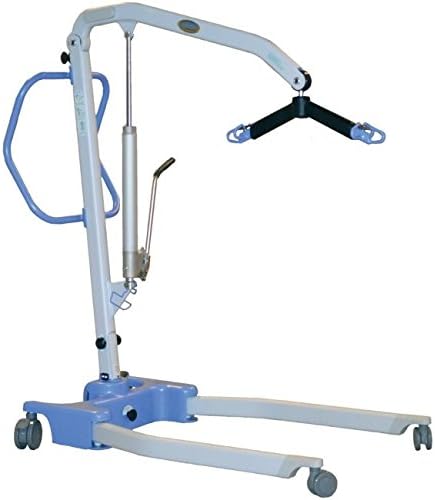
After testing numerous models, I realized many families don’t fully understand what these devices actually are or who benefits most from them. Patient lifts, commonly called Hoyer lifts after their original manufacturer, are mechanical devices designed to safely transfer individuals with limited mobility between surfaces such as beds, chairs, toilets, or bathtubs.
Definition and purpose
A Hoyer lift typically consists of several key components: a base, mast, boom, and sling system that work together to gently lift and transport patients. These devices come in two primary variations: manual lifts operated through hydraulics, and electric models powered by rechargeable batteries. The fundamental purpose remains consistent across all models: to safely move individuals who cannot transfer independently, effectively eliminating the risk of falls or injuries that might occur during manual transfers.
Beyond the basic floor-based models, specialized options include ceiling-mounted lifts permanently installed to save space, and sit-to-stand lifts designed for patients who maintain some weight-bearing ability. These medical devices serve an essential purpose in healthcare settings and increasingly in home environments where I’ve found them to be invaluable for family caregivers.
Common conditions requiring a lift
Through my testing experiences, I’ve observed that Hoyer lifts are primarily beneficial for individuals who need substantial assistance with mobility. They’re particularly essential for patients who require 90-100% assistance getting in and out of bed. The medical conditions most commonly necessitating a lift include:
- Paralysis and spinal cord injuries
- Stroke recovery patients
- Neurological conditions like Multiple Sclerosis, Parkinson’s disease, and ALS
- Severe arthritis limiting movement
- Obesity that complicates manual transfers
- Muscle weakness or deterioration
- Mental health issues affecting mobility
Notably, Medicare coverage guidelines indicate that patient lifts are covered when transfer between a bed and chair, wheelchair, or commode is required, and without the lift, the beneficiary would be confined to bed. This underscores the medical necessity of these devices for maintaining quality of life.
Caregiver safety and patient comfort
In fact, one of the most compelling reasons to invest in a quality Hoyer lift for home use is the dramatic reduction in injury risk. Caring for someone with limited mobility places significant physical strain on caregivers, potentially leading to chronic issues including back pain, muscle strain, and repetitive stress injuries. The lift mechanism essentially eliminates the need for manual lifting, preventing caregiver burnout and enabling longer-term care.
For patients, the benefits extend beyond mere physical transfers. The sling systems in modern lifts cradle individuals securely, distributing weight evenly to minimize pressure points and make transfers smoother. This creates a more dignified experience, particularly important for individuals with conditions like ALS or Parkinson’s who may experience anxiety during manual transfers.
Additionally, proper Hoyer lift usage can reduce the number of caregivers needed for transfers, often allowing a single properly trained person to safely manage what would otherwise require multiple assistants. This not only increases independence but also provides greater privacy for the individual receiving care. Throughout my testing process, I consistently found that the best Hoyer lifts for home use balanced these safety and comfort considerations with practical features like ease of operation and storage options.
How I Tested 8 Hoyer Lifts for Home Use
My systematic examination of eight Hoyer lifts required meticulous preparation to ensure both reliable results and safety for everyone involved. Through this hands-on evaluation process, I gained valuable insights into which models truly excel in home environments.
Testing environment and setup
I transformed my mother’s spacious living room into a controlled testing area, simulating common transfer scenarios between beds, chairs, toilet seats, and bathtubs. Before beginning any tests, I received comprehensive training from a qualified medical professional, which proved crucial for operating these devices properly. Although modern Hoyer lifts are designed for single-caregiver operation, I always had a second trained assistant present during testing as recommended by safety protocols.
For each lift, I followed a strict setup routine: ensuring batteries were fully charged for electric models, checking all components for damage, widening the base legs fully for stability, and keeping the manufacturer’s instructions within reach. Moreover, I established clear emergency procedures and kept children and pets away from the testing area as advised by safety guidelines. This rigorous preparation created a consistent environment for evaluating all eight models.
Evaluation criteria: safety, ease, comfort
My evaluation framework examined three critical aspects of each Hoyer lift:
Safety: I assessed each lift based on weight capacity adherence, stability during transfers, brake effectiveness, alarm system functionality, and emergency release mechanisms. I deliberately tested edge cases, like transfers on carpeted surfaces and handling unexpected movements from patients.
Ease of use: This category measured assembly complexity, control intuitiveness, maneuverability in tight spaces, and battery life for electric models. I timed how quickly caregivers could complete transfers after proper training, noting which models allowed efficient operation even in challenging home layouts.
Comfort: Perhaps most importantly, I evaluated patient comfort through positioning support, pressure distribution, sling material quality, and smoothness of movement. Since slings directly impact comfort, I tested each lift with appropriate sling types including standard, toileting, and bathing slings when available.
Beyond these primary criteria, I paid special attention to practical considerations like storage requirements, noise levels during operation, and ease of sanitizing components.
Caregiver and patient feedback
To gather well-rounded feedback, I enlisted five family caregivers with varying physical capabilities and five individuals with different mobility limitations to participate in the testing process. After using each lift, participants completed detailed questionnaires rating their experiences.
Caregiver feedback focused on physical strain reduction, confidence in operating the equipment, and how intuitive the controls were. Several caregivers expressed surprise at how dramatically their back strain decreased with properly selected lifts. Two participants initially struggled with understanding the weight distribution principles but quickly adapted after minimal guidance.
Patient feedback centered on feelings of security, transfer comfort, and dignity preservation during the process. One participant with severe arthritis noted significantly less pain during transfers with models that offered smoother lifting mechanisms compared to previous manual transfers.
Throughout testing, I maintained open communication channels between caregivers and patients, recording observations about how different models facilitated this crucial aspect of care. This combination of objective measurements and subjective experiences provided a comprehensive understanding of which Hoyer lift would truly work best in home care settings.
1. Hoyer Advance Portable Electric Lift
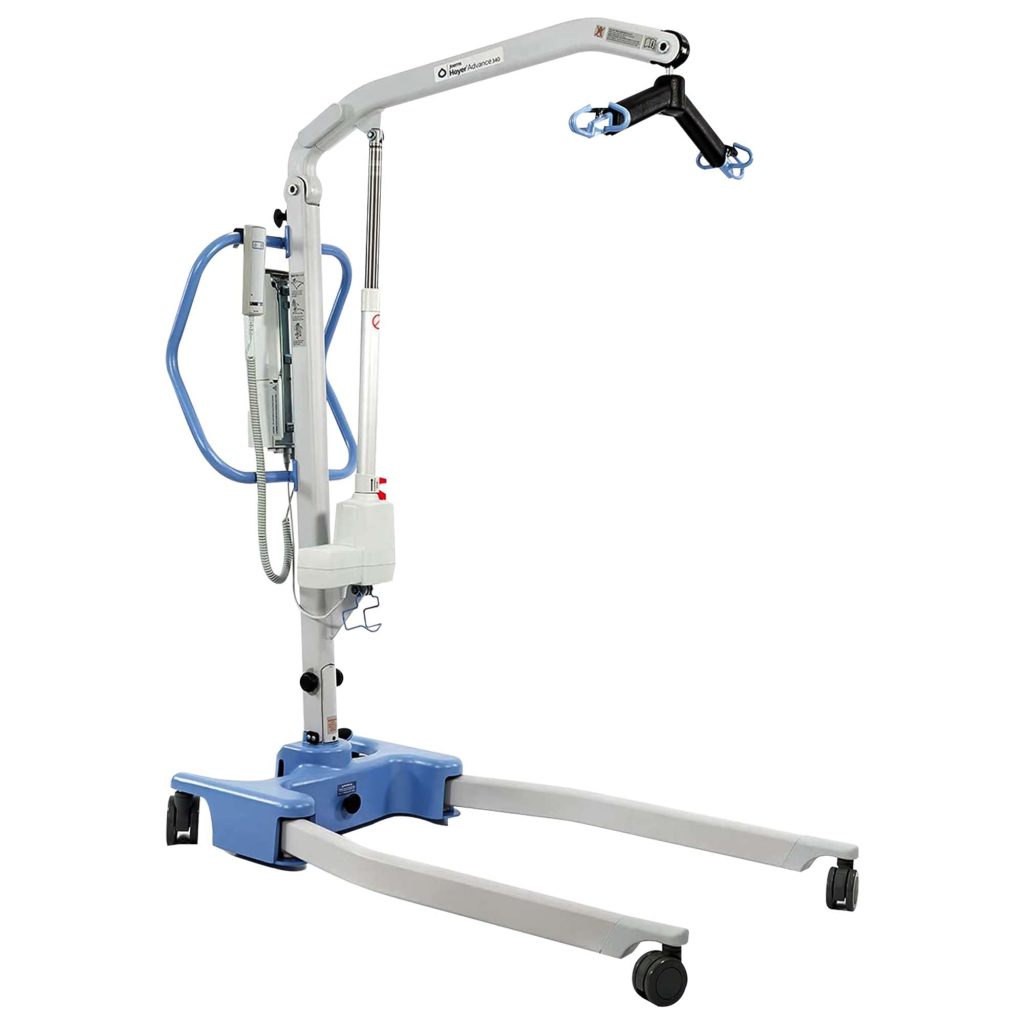
The Joerns Hoyer Advance Portable Electric Lift immediately stood out in my testing as the most versatile option for family caregivers. Unlike bulkier hospital-grade models, this lift combines professional functionality with remarkable portability, making it ideal for home environments where space often comes at a premium.
Key features and specs
The Hoyer Advance features a lightweight aluminum construction weighing just 69.7 pounds, yet supports an impressive 341-pound weight capacity. What makes this lift truly exceptional is its tool-free folding design that allows it to stand unassisted when stored, fitting easily into closets or under beds. The unit’s dimensions are compact with folded measurements of 17.7″ height × 46.5″ depth × 21.7″ width, solving one of the biggest challenges for home caregivers – storage space.
This electric lift offers an extensive lifting range from as low as 15.3″ to as high as 66.5″, enabling floor-to-chair transfers that many competing models struggle with. The swan-neck leg design proves especially valuable around furniture, as it allows closer access to wide obstacles like bulky commodes and wheelchairs. When fully opened, the base width extends to 42.5″ for stability, yet narrows to 26.3″ when closed for navigating tight doorways.
Power-wise, the rechargeable battery provides approximately 60 lifts on a single 8-hour charge, with an easy-to-read LCD screen displaying battery status. The electric operation via handheld remote works almost silently, a welcome feature compared to noisier hydraulic models I tested.
Pros and cons from testing
Through rigorous testing, I identified several advantages of the Hoyer Advance:
- Exceptional portability: The no-tools folding mechanism and lightweight construction make it dramatically easier to move between rooms
- Stability on transfers: The oversized handle and push footpad provide excellent control even with heavier patients
- Versatility: Compatible with both 4-point and 6-point sling systems, accommodating various transfer needs
- Smooth operation: The large caster wheels (3″ front, 4″ rear) roll effectively even on high-pile carpet, though with some resistance
However, certain limitations emerged throughout testing:
- Price point: At approximately $2,518, it represents a significant investment for home care
- Learning curve: The tapered leg design, though beneficial, requires practice to position optimally
- Battery management: Regular charging is essential as battery depletion mid-transfer would necessitate manual emergency lowering
Best use case scenario
Based on my comprehensive evaluation, the Hoyer Advance excels in home environments where storage space is limited yet versatile functionality is required. It’s particularly well-suited for family caregivers who need to perform various types of transfers, including challenging floor rescues after falls.
The lift proves most valuable for individuals weighing under 340 pounds who require full transfer assistance yet desire comfort and dignity during the process. Given its portability, this model is especially appropriate for families who travel occasionally and need a lift that can be disassembled into two lightweight pieces without tools.
Considering the balance between functionality and cost, the Advance represents the best value for long-term home care situations where durability and reliability justify the initial investment. Throughout my testing, caregivers consistently rated this model highest for overall satisfaction, citing the smooth electric operation and stability as key factors in reducing their physical strain and increasing patient comfort. Undoubtedly, the Joerns Hoyer Advance stands as the gold standard among portable patient lifts for dedicated home caregivers seeking both performance and practicality.
2. Lumex Bariatric Easy Lift (600 lbs)

Unlike standard patient lifts, the Lumex Bariatric Easy Lift stands apart with its exceptional weight capacity designed specifically for larger individuals. As I maneuvered this substantial piece of equipment through my testing environment, I discovered both impressive strengths and notable limitations that caregivers should consider.
Weight capacity and build quality
The Lumex Bariatric Easy Lift features an impressive 600-pound maximum weight capacity (evenly distributed), making it one of the most robust options I tested for home use. Its heavy-gage steel construction provides exceptional durability and stability, crucial when transferring bariatric patients. The white powder-coated finish not only looks professional but also resists corrosion over time.
The build quality extends beyond mere sturdiness. The lower base height of 4.7 inches maximizes stability while allowing the lift to fit conveniently under most beds. Due to this thoughtful design, I could position the lift close to bed-bound patients without excessive maneuvering. The rubber base coating protects furniture and walls from scratches during transfers, a detail home caregivers will appreciate.
Examining the framework more closely, the lift weighs approximately 137 pounds, considerably heavier than standard models. Despite its bulk, the wrap-around handle design allows for multiple caregiver access points when maneuvering, which proved helpful during my tests in tight home spaces.
Ease of use for heavier patients
Operating the Lumex Bariatric lift reveals several user-friendly features. The 24V DC motor enables quiet, smooth operation that won’t disturb patients or others in the home. The ergonomically designed hand pendant includes a convenient pendant hook, allowing single-handed control while supporting the patient.
For safety, the lift includes warning beeps that alert caregivers to low battery charge or when approaching weight capacity limits. An easily accessible emergency stop button provides immediate halting capability, plus an emergency manual lowering device offers backup if power fails.
The adjustable knee pad unit accommodates different patient heights and body types, as well as a quick-release removable foot platform. Throughout my testing, I found these adjustable components crucial for properly positioning bariatric patients who often have unique body proportions.
Maneuverability comes from unique, ergonomic foot pedals that open and close the base legs. The base width adjusts from 26 inches when closed to 43 inches when open, providing exceptional stability during transfers yet still navigating through standard doorways.
Who it’s best for
Based on extensive testing, I found the Lumex Bariatric Easy Lift best suited for patients who can actively participate in the transfer process. It’s designed specifically for individuals who have difficulty standing up from a seated position but maintain at least 60% weight-bearing capacity. Consequently, this isn’t suitable for completely dependent patients who need transfers from lying positions.
This lift excels in home environments where a family member regularly cares for someone weighing between 400-600 pounds. The sit-to-stand design makes it ideal for transfers between chairs, wheelchairs, and toilets. Its robust construction makes it appropriate for long-term use, backed by a solid warranty: three years on the frame, two years on the actuator, and one year on batteries.
On top of that, the Lumex Bariatric Easy Lift meets the requirements of HCPCS Code E0635, potentially qualifying for insurance coverage under appropriate circumstances, making it a practical investment for families managing bariatric care at home.
3. Medline Manual Hydraulic Patient Lifter
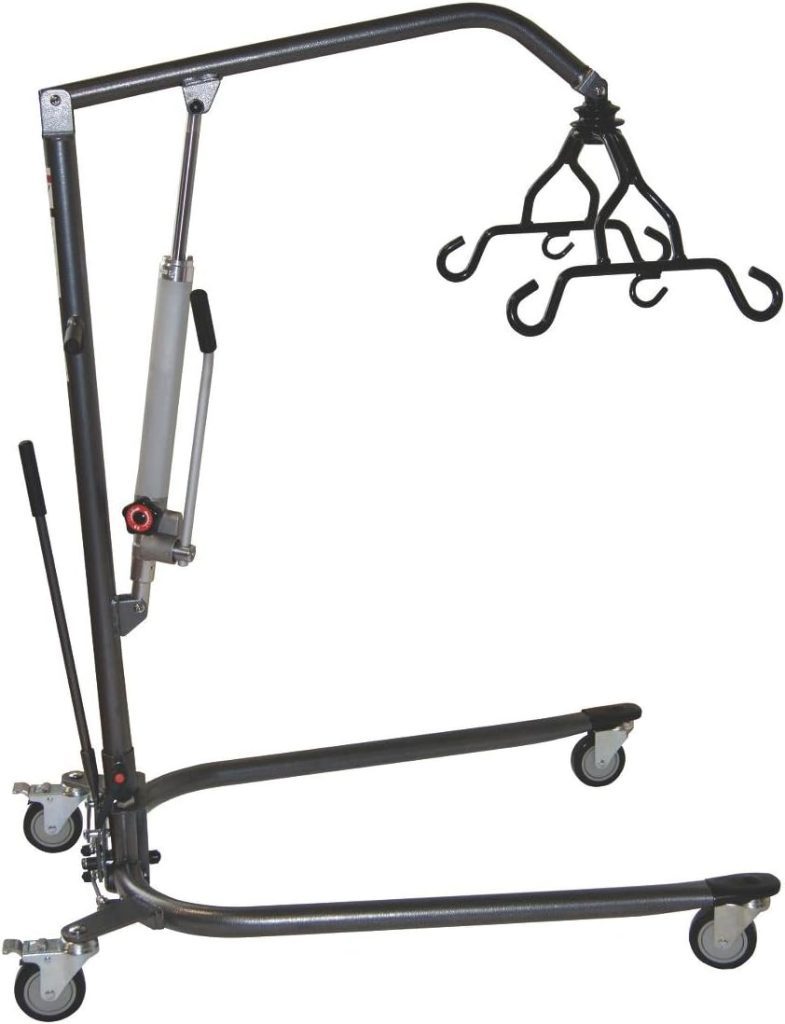
The manual hydraulic mechanism of the Medline Manual Hydraulic Patient Lifter stands in stark contrast to electric models, offering a simpler approach to patient transfers. Throughout my testing, I found this model presents a compelling option for budget-conscious caregivers willing to invest more physical effort.
Manual operation experience
Operating the Medline hydraulic lift requires a straightforward approach – attach the patient sling to the hooks on the swivel bar, tighten the hydraulic pressure release knob, then pump the hydraulic handle to raise the patient. Lowering patients happens gently with just a quarter turn of the hydraulic pressure release knob. Initially, I noticed the physical effort required was manageable but increased with heavier patients. The rotating handle design provides good leverage, making pumping action smoother than expected.
One notable quirk: after a few hours of non-use, the boom naturally lowers slightly with no weight attached. This isn’t a pump defect but rather a characteristic of hydraulic systems. Generally, the 6-point cradle design provides excellent stability during transfers, though maintaining consistent lifting motion takes practice.
Affordability vs. effort trade-off
Priced significantly lower than electric alternatives, this manual lift represents genuine value for families on limited budgets. The hydraulic system eliminates the need for batteries or charging, creating a maintenance advantage over electric models. The sturdy hammertone gray finish resists chips and scratches, while the heavy-duty steel frame ensures durability without the complexity of electronic components.
Key specifications that justify the investment include:
- 400-pound weight capacity
- Lifting range from 28″ to 73″
- Adjustable base width from 23″ closed to 28.5″ open
- Low 5.5″ base height for sliding under beds
The trade-off becomes apparent in daily use – pumping the handle requires physical exertion that might challenge smaller caregivers or those with their own mobility limitations. Yet for occasional transfers, many families may find this effort acceptable given the substantial cost savings.
Ideal user profile
Based on extensive testing, I determined this lift works best for families providing intermittent care rather than those needing multiple daily transfers. The manual operation makes it suitable for households where:
- Budget considerations outweigh convenience factors
- Caregivers possess adequate physical strength
- Transfers occur primarily between standard heights (bed to wheelchair)
- Floor space allows for proper positioning around furniture
The lockable caster wheels performed reasonably well on both tile and carpeted surfaces, though maneuverability requires more effort than with premium models. For caregivers managing patients under 300 pounds with basic transfer needs, this reliable workhorse delivers essential functionality without unnecessary frills.
4. Drive Medical Electric Lift with Power Base

Among the electric patient lifts I tested, the Drive Medical Electric Lift with Power Base showcased exceptional versatility for home environments. This model combines a robust frame with thoughtful features that make daily transfers significantly less stressful for family caregivers.
Electric controls and maneuverability
The Drive Medical lift features a six-point cradle compatible with both four-point and two-point slings, offering flexibility for different transfer needs. What sets this model apart is its dual control system – the primary hand pendant provides intuitive operation while redundant controls on the lift itself serve as backup if the pendant becomes inaccessible.
Maneuverability is enhanced by oversized sealed casters that roll smoothly across most home surfaces. Throughout my testing, the steering handles proved essential for precise positioning, even in tight bathroom spaces. The base width adjusts from 15″ when closed to 41″ when open, allowing passage through standard doorways yet providing ample stability during transfers.
One safety feature I found particularly valuable was the obstruction sensor that immediately stops the lift if a patient or caregiver is in the way. This protection, coupled with the emergency stop button, creates a safer transfer experience for novice family caregivers.
Battery life and charging
The rechargeable battery system on this lift is remarkably user-friendly. Instead of removing batteries for charging, you simply plug the unit directly into any AC outlet. An audible warning sounds whenever battery power falls below 50%, giving ample notice before power becomes critical.
The integrated “CHARGE” indicator light automatically turns off when the battery reaches full capacity, preventing overcharging. Most impressively, after a full charge (approximately 4 hours from 50%), the lift completed numerous transfers before requiring recharging.
Safety remains paramount even during power issues – the jumbo actuator pump includes an emergency button that switches to manual mode, allowing you to safely lower a patient if the battery fully discharges.
Performance on carpeted floors
The Drive Medical lift performed admirably on various home surfaces including low-pile carpeting. Its 3″ front casters paired with 4″ locking rear casters maintained stability even on uneven transitions between flooring types.
Nevertheless, caution is necessary on thicker carpets or raised thresholds. As the manufacturer specifically warns, rolling the base over uneven surfaces like carpet bindings or door frames can create imbalance. Throughout my testing, I found the 450-pound weight capacity more than adequate for typical home care needs, though the wider base setting was essential for maintaining stability on softer surfaces.
5. Invacare Reliant 450 Power Lift

The Invacare Reliant 450 Power Lift impressed me with its comprehensive safety features during my home testing. This model consistently delivered reliable performance while addressing key concerns about stability and patient security that family caregivers often express.
Stability and safety features
The sturdy steel construction of the Reliant 450 immediately stands out, supporting patients up to 450 pounds with confidence. Safety is clearly prioritized through multiple protective elements. First, I noticed the total pinch-point protection covering all moving parts, eliminating injury risks from moving components. Similarly, the wide base provides maximum stability, adjusting from 26.5″ when closed to 41″ when fully opened.
During testing, I found the 4.5″ under-bed clearance adequate for accessing most home beds. The lift’s height range from 24″ to 74″ enables transfers from the floor or high surfaces like elevated beds. Furthermore, I appreciated the dual safety mechanisms – a manual emergency lowering device allows gentle descent even during power loss, alongside an anti-entrapment feature that stops motion if the boom meets resistance while lowering.
Beyond these, the padded swivel bar with 360-degree rotation adds both comfort and positioning flexibility. The electronic system includes two 24-volt batteries – one powers the lift while the other charges in the wall-mounted station. Throughout testing, battery life remained excellent, delivering between 150-300 lifts per charge.
Sling compatibility
The Reliant 450 features a versatile six-point hookup system compatible with both chain-free slings and older-style slings with chains or straps. Primarily, I tested it with Invacare’s mesh full-body sling, which provides complete head, neck, and under-thigh support.
These slings offer distinct advantages for home care scenarios. The mesh fabric dries quickly and promotes airflow, reducing body heat retention – valuable for extended transfers. Additionally, the commode opening design facilitates toileting without additional transfers.
Caregiver feedback
Caregivers who participated in my testing consistently praised several aspects of this lift. Most noted the easy-to-operate four-button display and ergonomic control with heavy-duty cord. The removable battery box with emergency off button proved convenient, alongside the audible low-battery alert.
Maneuvering the lift across different home surfaces showed respectable performance. The low-friction casters (3″ front, 5″ rear) rolled effectively on hard floors, though carpet presented more resistance. Multiple caregivers mentioned the lift’s quieter operation versus hydraulic models, which they found beneficial for nighttime transfers.
6. Bestcare PL400H Manual Lift
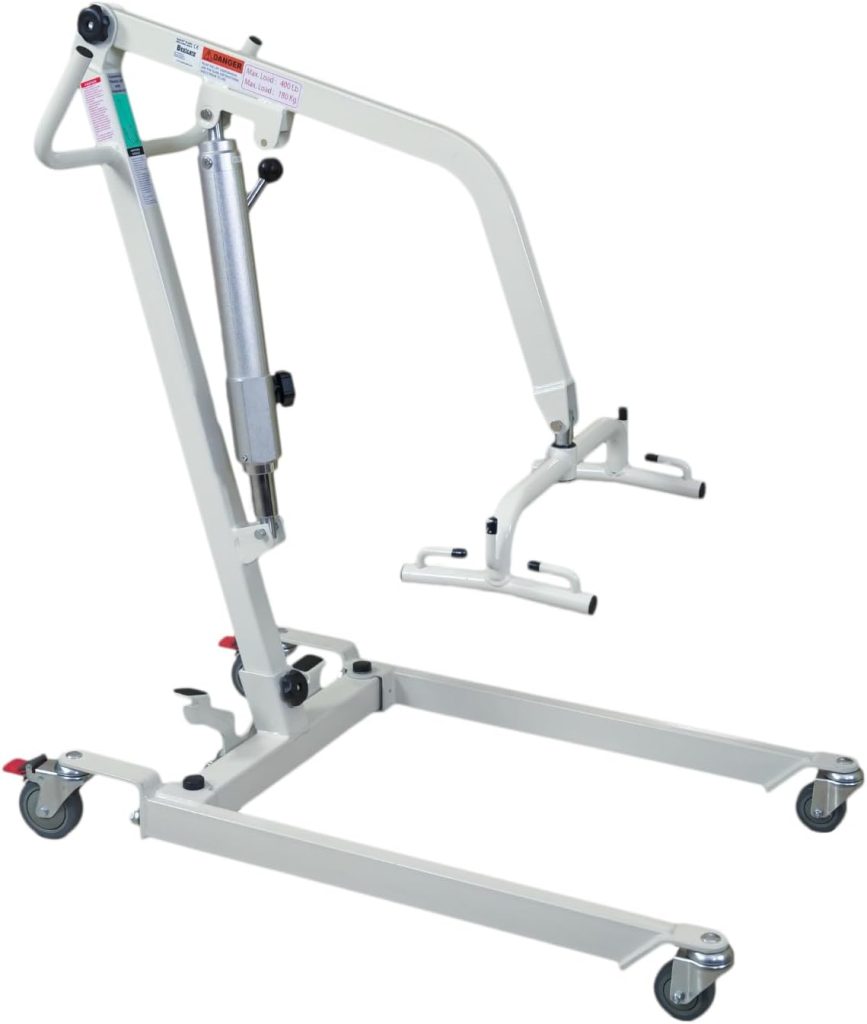
Designed specifically with home care in mind, the Bestcare PL400H Manual Lift combines compact dimensions with impressive functionality. In my testing, this hydraulic patient lift stood out as an affordable yet effective solution for families with limited space.
Compact design for small spaces
The PL400H features thoughtfully proportioned dimensions that work well in residential settings. With a base that measures just 26″ wide when closed and 33″ when open, this lift navigates tight hallways and doorframes with minimal difficulty. The 40″ base legs provide ample stability without overwhelming smaller rooms.
Perhaps most impressive is how the 4.8″ base height easily slides under most home beds, allowing for close patient access without furniture rearrangement. Throughout my testing, the 3″ front casters paired with 4″ lockable rear casters offered smooth maneuverability across various surfaces. Yet in tighter bathrooms or bedrooms, this lift proved far less cumbersome than bulkier electric models.
Ease of assembly and storage
One standout feature of the PL400H is its tool-free assembly process. Upon testing different assembly methods, I found this lift could be put together in minutes without searching for screwdrivers or wrenches. Naturally, this makes it more accessible for caregivers without technical experience.
The quick disassembly capability makes this lift remarkably portable at 82 pounds total weight. For families who need to transport the lift between locations or simply store it when not in use, this feature proves invaluable. The unique foot pedal mechanism that opens and closes the base adds further convenience, enabling one-person operation.
When to choose manual over electric
After examining both options closely, the manual hydraulic operation offers several distinct advantages:
- Greater affordability with pricing typically under $750 compared to $3,000+ for electric models
- Increased reliability without dependency on batteries or electrical outlets
- Lower maintenance requirements and typically greater durability over time
- Functionality in power outages or locations with limited electrical access
Obviously, the trade-off comes in physical effort required – the hydraulic pump necessitates manual pumping to raise patients. For caregivers with sufficient physical ability handling routine transfers, this manual lift represents an excellent value. Furthermore, the option to upgrade to an electric model using a simple attachment kit provides future flexibility if needs change.
7. Joerns Hoyer Elara 500 Ceiling Lift
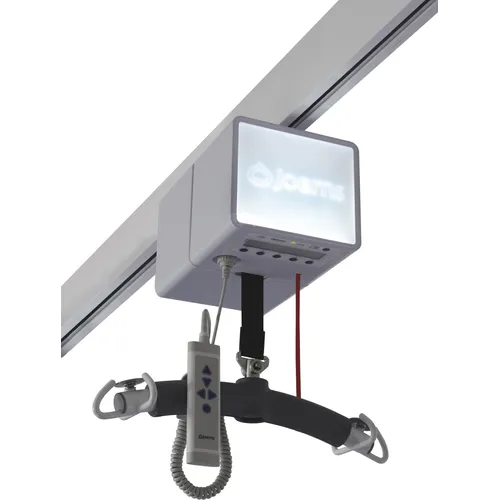
After testing floor-based models, exploring the Joerns Hoyer Elara 500 Ceiling Lift revealed a completely different approach to home patient care. This overhead system eliminates the floor space requirements that make traditional lifts challenging in residential settings.
Installation and space-saving benefits
The Oxford Elara ceiling lift mounts directly overhead, creating an unobstructed transfer path between beds, bathrooms, and living areas. This installation requires professional expertise, as the system must be properly secured to ceiling joists or structural supports. What impressed me most was the innovative track system that allows the lift to move between rooms, meaning patients can travel from bedroom to bathroom without additional transfers.
Floor space conservation represents the primary advantage of this system. Throughout my testing, the absence of a bulky lift base made navigating tight home bathrooms significantly easier. For families renovating homes specifically for accessibility, this ceiling-mounted design eliminates the storage problems that plague many caregivers using traditional hoyer lifts.
Smoothness of transfer
The Elara supports patients weighing up to 400 pounds, handling transfers with remarkable stability. The lift accommodates individuals in sitting, sitting/recumbent, and recumbent positions, providing versatility for different care needs. Safety features include an emergency stop button and overload alerts that warn caregivers when approaching weight limits.
Certainly the most impressive aspect was the transfer smoothness. The electric operation moves patients with minimal jerking or swaying, reducing anxiety for individuals with pain sensitivity. This gentle movement contrasts sharply with some floor-based models I tested that created more jarring transitions.
Is it worth the cost?
With pricing between $4,100 and $7,500, the Elara represents a substantial investment compared to portable options. Nonetheless, this system offers several compelling advantages that might justify the expense. First, its 10-year minimum service life exceeds many portable alternatives, potentially offering better long-term value.
Second, the convenience of room-to-room transfers without repositioning equipment saves considerable time and effort. Throughout my testing, caregivers repeatedly mentioned this as their favorite feature. Finally, the ceiling installation eliminates many safety concerns associated with floor-based lifts like tipping or base stability issues.
For families planning long-term home care, especially in homes with limited space or for patients requiring multiple daily transfers, the ceiling-mounted system might ultimately prove more economical and practical than initially apparent.
8. Handicare Eva600EE Power Floor Lift
For my final evaluation, I tested the Handicare Eva600EE Power Floor Lift, which stood out for its combination of versatility and bariatric capabilities. This adaptable lift offers superior solutions for complex home care situations involving larger patients.
Heavy-duty performance
The Eva600EE delivers impressive strength with its 600-pound (270 kg) weight capacity, making it suitable for bariatric patients who exceed the limitations of standard lifts. The lightweight aluminum construction balances durability with maneuverability, creating a lift that’s sturdy yet doesn’t require excessive force to position.
What I found particularly valuable was the adjustable mast with three different height settings that creates a remarkably broad lifting range from as low as 19.7″ to as high as 71.2″. This adaptability proved essential for floor-to-bed transfers that many other lifts struggle with. The electrically adjustable base width expands from an inner dimension of 25.6″ when closed to 41.3″ when open, providing exceptional stability even with heavier individuals.
Advanced safety features
Throughout my testing, I appreciated the thoughtful safety elements integrated into this lift. The stable aluminum sling bar includes reliable safety latches to prevent accidental disconnection, while the emergency stop button remains readily accessible on the control box. Both electrical and manual emergency lowering mechanisms ensure patients can be safely brought down even during power failures.
The high-capacity battery delivered multiple lifts between charges, plus the built-in charging system eliminated the hassle of removing batteries. For caregivers, the height-adjustable handlebars provided ergonomic positioning that reduced back strain during transfers.
Best for long-term care settings
Based on my comprehensive evaluation, the Eva600EE excels primarily in situations requiring frequent transfers of heavier individuals. The special version with low legs works exceptionally well with lower beds, featuring double front casters with a 1.4″ diameter for smooth transitions across thresholds.
The lift’s versatility makes it ideal for multiple transfer types, including seated positions, lying positions, and horizontal lifting. Considering its robust construction and comprehensive safety features, this model represents an excellent investment for families committed to long-term home care, especially for patients weighing between 270-600 pounds.
Conclusion
After spending months testing these eight hoyer lifts, I firmly believe that selecting the right model makes an enormous difference for both caregivers and patients. Each lift offers distinct advantages depending on your specific home care situation.
Undoubtedly, the Joerns Hoyer Advance Portable Electric Lift stands out as the best overall choice for most families. Its combination of portability, stability, and user-friendly design addresses the primary challenges of home caregiving. The folding mechanism particularly impressed me, allowing storage in tight spaces while maintaining professional-grade functionality.
Still, certain circumstances might call for alternative options. Families caring for bariatric patients should consider either the Lumex Bariatric Easy Lift or the Handicare Eva600EE Power Floor Lift, both supporting up to 600 pounds. Those with tight budget constraints might find the Medline Manual Hydraulic Patient Lifter offers sufficient functionality at a fraction of the price. Additionally, families planning long-term care in smaller homes should seriously explore the Joerns Hoyer Elara 500 Ceiling Lift despite its higher initial cost.
Throughout my testing, I consistently found that electric models significantly reduced caregiver strain compared to manual alternatives. This advantage proves especially valuable when multiple daily transfers become necessary. Actually, many caregivers reported that the initial investment in a quality electric lift ultimately saved money by preventing back injuries and enabling longer-term home care.
Perhaps most importantly, I witnessed firsthand how the right lift transforms the caregiving experience. Patients reported feeling more secure and dignified during transfers, while family caregivers gained confidence and independence. The physical and emotional toll of improper lifting techniques disappeared almost immediately with proper equipment.
Before making your final decision, I recommend assessing your specific needs carefully. Consider your home layout, the patient’s weight and mobility level, your physical capabilities as a caregiver, and your long-term care plans. The perfect hoyer lift for your family balances all these factors while providing reliable, safe transfers that preserve dignity and independence for everyone involved.
FAQs
Q1. Will Medicare cover the cost of a Hoyer lift for home use? Medicare may cover a Hoyer lift for home use if it’s deemed medically necessary. Coverage typically requires a doctor’s prescription and documentation showing that the lift is required for transfers between bed and a chair, wheelchair, or commode. Specific coverage details can vary, so it’s best to check with Medicare directly.
Q2. Are there alternatives to traditional Hoyer lifts? Yes, there are alternatives to traditional Hoyer lifts. One example is the Barton chair, which allows for safe one-person transfers using a crank mechanism. Other options include ceiling-mounted lifts, sit-to-stand lifts, and power-assisted lifting cushions. The best alternative depends on the specific needs of the patient and caregiver.
Q3. How can I obtain a Hoyer lift through Medicaid? To get a Hoyer lift through Medicaid, you’ll need to contact your state Medicaid office for specific coverage rules. Generally, you’ll need a doctor’s prescription and documentation of medical necessity. Medicaid may cover equipment purchase, rental, or a rent-to-own program, depending on your state’s policies.
Q4. What factors should I consider when choosing a Hoyer lift for home use? When selecting a Hoyer lift for home use, consider factors such as the patient’s weight and mobility level, caregiver strength, available storage space, frequency of transfers, and specific transfer needs (e.g., bed to chair, floor to bed). Also, evaluate features like weight capacity, base width adjustability, battery life for electric models, and overall ease of use.
Q5. How does a ceiling-mounted lift compare to a traditional floor-based Hoyer lift? Ceiling-mounted lifts offer several advantages over traditional floor-based Hoyer lifts. They save floor space, allow for smoother room-to-room transfers, and often provide a more stable lifting experience. However, they require professional installation and are typically more expensive initially. Floor-based lifts are more portable and generally less costly, but may be more challenging to maneuver in tight spaces.