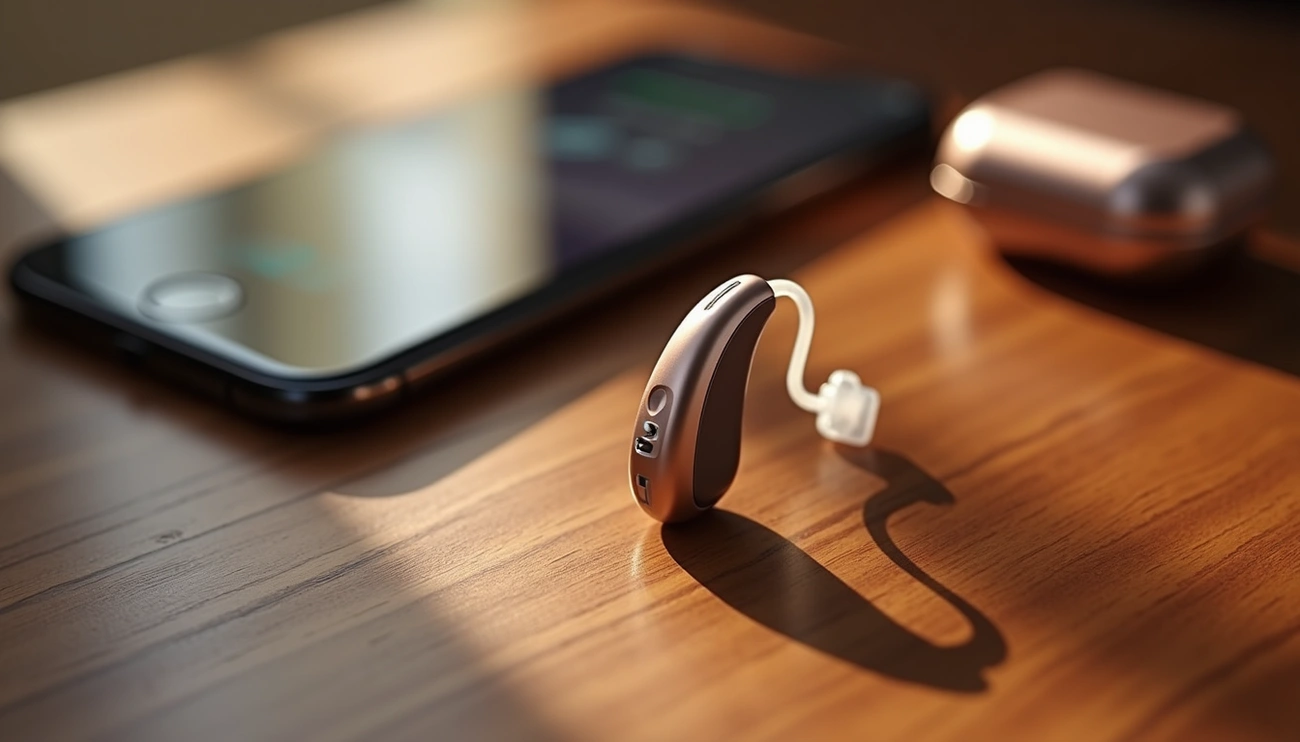
Choosing the right hearing aids can feel overwhelming when you’re researching options for yourself or a loved one experiencing hearing loss. Oticon hearing aids represent more than a century of hearing technology innovation, with the Danish company now serving as the world’s second-largest hearing aid manufacturer.
With 3,000 employees worldwide and distribution across 100 countries, Oticon has built a substantial presence in the hearing healthcare market. The company’s devices cost between $2,598 and $4,898 per device, positioning them alongside other premium prescription manufacturers. These hearing aids deliver clarity that provides 35% more access to speech cues and performance that ranks in the top 5% of prescription devices tested.
You may wonder whether these premium-priced devices justify their cost compared to other hearing aid options. The answer depends on understanding what sets Oticon apart from competitors and how their features address specific hearing challenges you face.
This review examines Oticon’s key features, pricing structure, and real-world performance to help you determine whether these hearing aids offer the right solution for your hearing health needs.
What Is Oticon and Who Is It For?
Personal stories often drive the most meaningful innovations in healthcare technology. Hans Demant founded Oticon in 1904 after purchasing a hearing device for his wife Camilla, who experienced hearing loss. What began as one man’s effort to help his wife has grown into a company that now operates from Denmark with production facilities across multiple countries, including Poland.
Oticon maintains its founding mission to “push the limits of hearing care technology and create a world where hearing loss is no limitation”. This dedication has positioned the company as a leader in developing technology based on research into hearing loss, cognitive health, and overall well-being.
Prescription vs OTC hearing aids
The introduction of over-the-counter (OTC) hearing aids in 2022 created new options for people with hearing loss. Understanding the differences between OTC and prescription models helps you make the right choice for your needs.
OTC hearing aids provide these benefits:
- Designed for perceived mild to moderate hearing loss
- More accessible without requiring audiologist visits
- Generally lower cost than prescription alternatives
However, OTC devices have important limitations. They lack comprehensive diagnostic testing that accurately identifies the extent and nature of hearing loss. Additionally, they don’t offer the custom fitting available with prescription hearing aids, which can result in suboptimal sound clarity and comfort.
Oticon’s prescription hearing aids require a thorough hearing evaluation by certified audiologists. These professionals identify the type and degree of hearing loss, allowing for device selection that addresses your specific needs. The devices are then programmed to match your individual hearing profile, delivering superior sound quality and comfort.
Target users: mild to profound hearing loss
Oticon serves both adults and children across every level of hearing impairment, from mild to profound. With more than 700 million people worldwide experiencing hearing loss-most over age 50 and about 8% under 18-this comprehensive approach addresses a substantial global need.
The company offers hearing aid models in various styles and price ranges to accommodate different preferences and budgets. Oticon has built a particularly strong reputation in pediatric amplification, providing specialized solutions for children in classroom settings and beyond.
For severe to profound hearing loss, Oticon offers specialized high-powered devices designed to maximize remaining hearing capabilities while maintaining speech clarity. Each device implements the company’s BrainHearing philosophy, an engineering approach introduced in 2014 that supports the brain by delivering sound in ways that make it easier to process and understand.
As research continues uncovering connections between hearing, cognition, and overall health, this brain-focused approach has become increasingly relevant for users across all hearing loss categories.
Oticon Hearing Aid Models and Key Features
Understanding Oticon’s product lineup helps you identify which hearing aid might best address your specific hearing challenges. Each model builds on the company’s BrainHearing technology while offering distinct features designed for different needs and budgets.
Oticon Intent: 4D sensors and BrainHearing
The flagship Oticon Intent introduces revolutionary 4D Sensor technology that monitors conversation activity, head movement, body movement, and acoustic environment. These sensors adapt sound processing to your specific listening intentions, even when you remain in the same environment. When you turn toward someone speaking or lean in during conversation, the sensors detect your communication intentions and improve speech comprehension by 15%.
Intent operates on the new Sirius platform, which powers MoreSound Intelligence 3.0 and incorporates an advanced second-generation Deep Neural Network (DNN 2.0). This AI technology learns through experience, processing sound more like the human brain to provide better access to speech in challenging environments. The DNN 2.0 has been trained on a greater diversity of complex sound samples, preserving original sound quality while suppressing unwanted noise by up to 12 dB.
Oticon Real and Zircon: Feature comparison
Oticon Real, released in 2023, builds on previous models with its Polaris R chip and MoreSound Intelligence 2.0 technology that scans sound environments 500 times per second. Real offers two notable improvements:
- Wind and Handling Stabilizer: Reduces noise from wind and physical handling
- Sudden Sound Stabilizer: Manages loud, unexpected noises without compromising speech clarity
Zircon serves as Oticon’s more budget-friendly option, powered by the same Polaris platform used in older More devices. Despite its lower price point, Zircon delivers 360° speech and clear sound, particularly in noisy environments. Both models are available in multiple styles including miniRITE and miniBTE options with varying technology levels.
Real achieved a SoundGrade of A in performance testing, ranking in the top 30% in the prescription category and top 20% of all devices tested by HearAdvisor. While Zircon offers fewer premium features, it maintains excellent connectivity options at a more accessible price point.
Rechargeable vs disposable battery options
You can choose between rechargeable and disposable battery options across Oticon’s product lines, depending on your lifestyle preferences. The rechargeable Intent models provide up to 20 hours of use on a full charge, with a quick 15-minute charge offering four hours of usage. Real’s rechargeable models deliver approximately 16 hours of use, though this may be shorter with extensive streaming.
For those preferring traditional batteries, disposable battery models typically provide 5-7 days of use per battery. These options offer greater flexibility if you travel frequently or have limited access to charging facilities.
Consider these factors when choosing battery types:
- Rechargeable models: Eliminate regular battery purchases and are more environmentally friendly, but require consistent access to electricity
- Disposable battery options: Provide greater convenience for extended wear periods and eliminate concerns about charging unit damage
Bluetooth and streaming capabilities
Connectivity represents a core strength across Oticon’s product range. Intent models feature the latest Bluetooth LE Audio technology, enabling direct streaming and two-way audio for hands-free calls on compatible Android devices and Windows PCs. This advanced connectivity makes Intent future-ready for upcoming technologies like Auracast broadcast audio.
All Oticon hearing aids with 2.4 GHz wireless technology are certified as Made for iPhone, allowing you to stream audio and make bi-directional audio and video calls on Apple devices. Many models also support the Android Protocol for Audio Streaming (ASHA), enabling direct streaming from select Android devices.
For additional connectivity, Oticon offers accessories like the ConnectClip remote microphone for distance and noisy situations and the TV Adapter for streaming television audio directly to the hearing aids. These accessories enhance device versatility, allowing you to stay connected to various audio sources throughout your daily activities.
Hidden Features That Make a Difference
Oticon hearing aids include several capabilities that don’t appear prominently in marketing materials but can significantly enhance your daily experience. These less-publicized features often determine long-term satisfaction with your hearing aids.
Tap control and motion sensors
The motion sensors in Oticon Intent enable intuitive tap controls, allowing you to adjust settings with a simple double-tap on your ear. This discreet control method eliminates the need to reach for your phone during social situations. The 4D Sensor technology tracks head movement and body orientation to recognize your listening intentions. When you turn toward someone speaking, the hearing aids immediately prioritize sound from that direction, creating a more natural listening experience. The sensors also detect when you lean in during conversation, automatically enhancing speech clarity in that focused moment.
Self-calibrating receivers and dome options
The MiniFit Detect receivers, introduced in 2024, represent a major advancement with their self-calibration technology. These are the world’s first receivers to automatically adjust, delivering gain accuracy within ±1 dB. This innovation provides up to 57% more precision compared to previous Oticon speaker units. The receivers come in three power levels (60dB, 85dB, and 100dB) with color-coded markers for easy identification. They’re compatible with various ear tips, including standard domes and custom-fit MicroShell Detect molds, ensuring optimal comfort and sound quality.
LE Audio and Auracast readiness
Oticon Intent hearing aids feature Bluetooth LE Audio, which offers direct streaming and two-way audio for hands-free calls on compatible Android devices and Windows PCs. LE Audio is more power efficient than traditional Bluetooth while delivering superior audio quality. Oticon hearing aids are Auracast-ready, a technology that will allow you to connect directly to public audio systems like airport announcements, museum guides, or church services. Connecting to an Auracast broadcast works similarly to joining Wi-Fi – simply scan for available broadcasts using your smartphone or hearing aid app.
Oticon Companion app and remote support
The Oticon Companion app provides several useful functions for managing your hearing aids:
- Sound equalization for personalizing low, mid, and high frequencies (±6 decibels)
- Individual volume control for streaming devices and environmental sounds
- Program switching between custom settings for different environments
- HearingFitness tracking to monitor daily wear time and set goals
- Remote Care sessions allowing audiologists to make adjustments without office visits
The app also features a “find my hearing aids” function and offers step-by-step instructions with helpful videos for new users.
Oticon Hearing Aids Cost and Value Analysis
Understanding hearing aid costs helps you determine whether Oticon’s premium pricing aligns with your budget and hearing needs. The investment in these devices involves more than the initial purchase price, as ongoing maintenance, insurance coverage, and long-term value all factor into your decision.
Price range: $2,598 to $4,898 per device
Oticon hearing aids fall squarely in the premium category, typically ranging from $2,598 to $4,898 per device. The flagship Intent models command the highest prices, with Intent 1 at the premium tier ($7,596 per pair), Intent 2 at the advanced tier ($6,212 per pair), and Intent 3 and 4 at standard and basic tiers ($5,456 and $3,600 per pair respectively). The Real series maintains similar pricing at its premium level ($7,596 for Real 1), whereas the more accessible Zircon line starts at approximately $2,598 per pair.
Many audiologists offer bundled pricing that includes professional services along with the devices themselves. These packages often include follow-up visits, adjustments, and cleaning services, making the total investment more comprehensive than the device cost alone.
Insurance and Medicare coverage options
Original Medicare does not cover hearing aids, creating a financial challenge for many seniors. Some Medicare Advantage (Part C) plans do include hearing aid coverage or discounts. Private insurance coverage varies significantly by individual plan, with some offering partial reimbursement or allowances toward hearing technology.
You should contact your insurance provider directly to understand what hearing aid benefits your specific plan provides. Some employers also offer hearing aid benefits through supplemental insurance or flexible spending accounts.
Warranty and repair policies
Most Oticon models include a three-year manufacturer warranty covering repairs and a one-time replacement if lost or damaged. The Play PX line exceeds this standard with a five-year warranty. Many providers also offer 30 to 45-day trial periods, allowing you to evaluate performance before committing fully.
This trial period proves especially valuable given the significant investment involved. You can test how well the hearing aids perform in your daily environments and whether the features justify the cost.
How Oticon compares to Phonak, Signia, and Jabra
Oticon provides slightly clearer sound in controlled tests, particularly for speech in noisy environments. However, Phonak edges out Oticon in Bluetooth stability and connection consistency. While priced similarly to Phonak and Signia ($1,000-$3,750 per device), Oticon typically offers better battery performance in disposable battery models.
The choice between these premium manufacturers often comes down to specific features that matter most to your lifestyle. Oticon excels in speech clarity, while competitors may offer advantages in connectivity or other specialized areas.
User and Expert Feedback: Pros and Cons of Oticon Hearing Aids
Understanding how Oticon hearing aids perform in daily use requires looking beyond manufacturer specifications to examine real-world experiences from both wearers and hearing professionals. These insights reveal important considerations for your decision-making process.
Pros: Sound clarity, comfort, and design
Users frequently highlight Oticon’s exceptional sound clarity, with many reporting they’ve rediscovered sounds they hadn’t heard in years. The Intent model enhances speech comprehension by 15% in challenging noise environments. Wearers appreciate the intuitive nature of the hearing aids “knowing what my brain wants to hear”. The sleek, slim design that hides effectively behind the ear receives frequent positive mentions.
Cons: Bluetooth stability and battery limitations
Bluetooth connectivity presents challenges for some users, with reports of sound bouncing between ears or dropping entirely, particularly when moving around. The connection between multiple devices (laptop, tablet, smartphone) can be clunky, requiring manual Bluetooth toggling. Battery life occasionally falls short of expectations, with some users reporting only 8 hours of use before shutdown.
Oticon hearing aids ratings from users
Consumer ratings show mixed results, with Trustpilot scores of 2.4/5 stars and BBB ratings of 1/5. However, individual testimonials often express satisfaction, with several users reporting devices lasting well beyond the expected 5-year lifespan.
Expert audiologist opinions
Professional evaluations remain largely positive, with audiologists expressing confidence in the brand. Formal testing shows Intent scored 97/100 for sound quality. Experts routinely recommend Oticon for its sturdy construction and natural sound reproduction.
Conclusion
Oticon hearing aids offer solid technology and proven performance for those seeking premium hearing solutions. The company’s BrainHearing approach delivers measurable benefits, with the Intent series providing 15% better speech comprehension in challenging environments through its 4D sensor technology.
The premium pricing of $2,598 to $4,898 per device reflects advanced features like tap controls, self-calibrating receivers, and Auracast readiness. These capabilities extend beyond standard hearing aid functions, though you should weigh these benefits against the substantial cost. Medicare limitations mean most seniors face significant out-of-pocket expenses for these devices.
User experiences reveal both strengths and challenges. Many wearers praise the exceptional sound clarity and comfortable design, with some rediscovering sounds they hadn’t heard in years. However, Bluetooth connectivity issues and occasional battery life limitations during streaming activities may frustrate some users.
Professional evaluations consistently rate Oticon highly, with the Intent model scoring 97/100 for sound quality . This strong clinical performance contrasts with mixed consumer ratings, suggesting these devices excel in controlled testing but face real-world connectivity challenges.
Oticon works best for individuals who prioritize sound quality and speech clarity over connectivity reliability. The three-year warranty provides reasonable protection, though you may want to consider extended coverage given the investment level.
Before purchasing, take advantage of the 30 to 45-day trial periods offered by many providers. This trial period allows you to evaluate whether Oticon’s impressive specifications translate to meaningful improvements in your daily hearing experience. You can also explore whether your audiologist offers bundled pricing that includes follow-up services, potentially improving the overall value proposition.
The choice ultimately depends on your specific hearing needs, budget constraints, and tolerance for occasional technical challenges. For those seeking the highest sound quality available and willing to invest in premium technology, Oticon represents a well-established option with proven clinical results.
Key Takeaways
Oticon hearing aids offer premium technology with proven benefits, but come with significant cost considerations and some connectivity challenges that potential users should carefully evaluate.
• Oticon’s flagship Intent model uses revolutionary 4D sensors to improve speech comprehension by 15% in noisy environments through advanced BrainHearing technology.
• Premium pricing ranges from $2,598 to $4,898 per device, placing Oticon in the high-end category with limited Medicare coverage options.
• Hidden features like tap controls, self-calibrating receivers, and Auracast readiness provide substantial value beyond standard marketing highlights.
• Users praise exceptional sound clarity and comfort, but report Bluetooth connectivity issues and occasional battery life limitations during heavy streaming.
• Professional ratings score 97/100 for sound quality, though mixed consumer reviews suggest performance varies significantly between individual users.
While Oticon excels in sound processing and speech clarity compared to competitors like Phonak and Signia, the substantial investment requires careful consideration of your specific hearing needs, budget constraints, and tolerance for occasional connectivity challenges.
FAQs
Q1. What is the price range for Oticon hearing aids? Oticon hearing aids typically cost between $2,598 and $4,898 per device, depending on the model and technology level. Premium models like Intent 1 can cost up to $7,596 per pair, while more budget-friendly options like Zircon start around $2,598 per pair.
Q2. What are some unique features of Oticon hearing aids? Oticon hearing aids offer several innovative features, including 4D sensor technology for improved speech comprehension, tap control for easy adjustments, self-calibrating receivers for precise sound delivery, and Auracast readiness for future connectivity to public audio systems.
Q3. How long do the batteries in Oticon hearing aids last? Rechargeable Oticon models like Intent provide up to 20 hours of use on a full charge, with a quick 15-minute charge offering four hours of usage. Disposable battery models typically last 5-7 days per battery. However, battery life may vary depending on usage patterns and streaming activities.
Q4. Are Oticon hearing aids compatible with smartphones? Yes, Oticon hearing aids offer extensive connectivity options. They are certified as Made for iPhone, allowing direct audio streaming from Apple devices. Many models also support the Android Protocol for Audio Streaming (ASHA) for select Android devices. The Oticon Companion app provides additional control and customization features.
Q5. What do users say about Oticon hearing aids? User feedback on Oticon hearing aids is mixed. Many users praise the exceptional sound clarity and comfort, with some reporting rediscovery of long-lost sounds. However, some users have experienced issues with Bluetooth stability and battery life during heavy streaming. Professional ratings for sound quality are consistently high, scoring 97/100 in formal testing.