Bay Alarm Medical testing reveals a response time of just 31 seconds when help is needed. This quick connection helps explain why 93% of users report “very positive and helpful” interactions with their customer service and monitoring center staff, which is 12% higher than the industry average of 81%. When you’re evaluating safety options for yourself or a loved one, response speed and service quality matter as much as monthly costs.
Speaking of costs, Bay Alarm Medical systems range from $24.95 to $39.95 per month, with entry-level options starting at $27.95 monthly for landline connections. Our testing covered their entire product lineup, from the basic home system to their SOS All-In-One 2 (which requires a one-time equipment fee of $89.40). You’ll want to understand what you’re actually paying for, how the different systems perform when you need them, and whether their fall detection technology justifies the additional cost.
This Bay Alarm Medical review examines the hidden fees many customers discover later, shares what our testing revealed about actual response times, and helps you determine if this system provides the protection and peace of mind you’re seeking.
What Is Bay Alarm Medical and Who Is It For?
Bay Alarm Medical has operated as a family-owned business since 1946, building expertise in personal emergency response systems over nearly 80 years of protecting families across America with life-saving medical alert technology. Based in California, the company now serves customers nationwide, including Alaska and Hawaii.
Overview of Bay Alarm Medical Systems
Bay Alarm Medical provides four primary medical alert systems, each addressing different safety needs and lifestyles. Their monitoring operates through two fully redundant USA-based emergency response centers in Ogden, Utah and Rexburg, Idaho. These centers hold CSAA Five Diamond certification, the industry’s highest standard, and undergo annual recertification plus random inspections.
The company’s product lineup includes:
- SOS Home – A traditional in-home system connecting to landline or cellular service, providing coverage throughout the residence
- SOS Mobile – A portable GPS-enabled device with location tracking for active seniors on the go
- SOS Smartwatch – A discreet wearable with modern design that doesn’t require a separate cell phone or plan
- SOS All-in-One – A hybrid solution offering both home and on-the-go protection through 4G LTE connectivity
Bay Alarm Medical’s monitoring service supports over 170 languages, ensuring families never encounter communication barriers during emergencies. Their monitoring centers function as complete duplicates, so if one station goes offline, the other immediately provides emergency coverage.
Monthly costs start at $24.95 for basic in-home protection and range to $39.95 for comprehensive offerings. Bay Alarm Medical operates without long-term contracts, allowing month-to-month payments and cancelation at any time.
Target Users: Seniors, Caregivers, and Families
Bay Alarm Medical systems benefit anyone seeking emergency protection, but prove particularly valuable for specific groups:
Independent Older Adults – These systems protect seniors living independently who want to maintain their autonomy while having reliable access to emergency assistance. The intuitive single-button operation means help is always one press away, which proves easier than fumbling with a cell phone during a crisis.
Families and Caregivers – For those concerned about elderly parents or relatives, especially those living at a distance, Bay Alarm Medical offers peace of mind. Their caregiver tracking feature allows designated contacts to monitor location data in real-time and receive alerts if the emergency button is activated. The company provides a free companion mobile app that allows caregivers to check device battery levels, view step tracking data, and manage emergency contact settings.
Individuals with Health Concerns – People with medical conditions, mobility challenges, or fall risks benefit particularly from the automatic fall detection option available on most devices. Our testing found Bay Alarm Medical’s response operators to be professional yet warm, making them suitable for users who might feel anxious about speaking with medical professionals during stressful situations.
The system operates through a simple three-step process: the user presses their SOS button, a trained agent assesses the situation through the two-way speaker, and appropriate help is dispatched – whether emergency services, family members, or neighbors. Users can customize their emergency contact preferences, deciding whether 911 or personal contacts should be reached first.
System Breakdown: SOS Home, Micro, Smartwatch, and All-in-One 2
Bay Alarm Medical offers four distinct medical alert systems, each designed for specific needs and lifestyles. Testing revealed significant differences in battery life, features, and overall performance across their product lineup. Here’s what you need to know about each system.
SOS Home: In-Home Coverage and Features
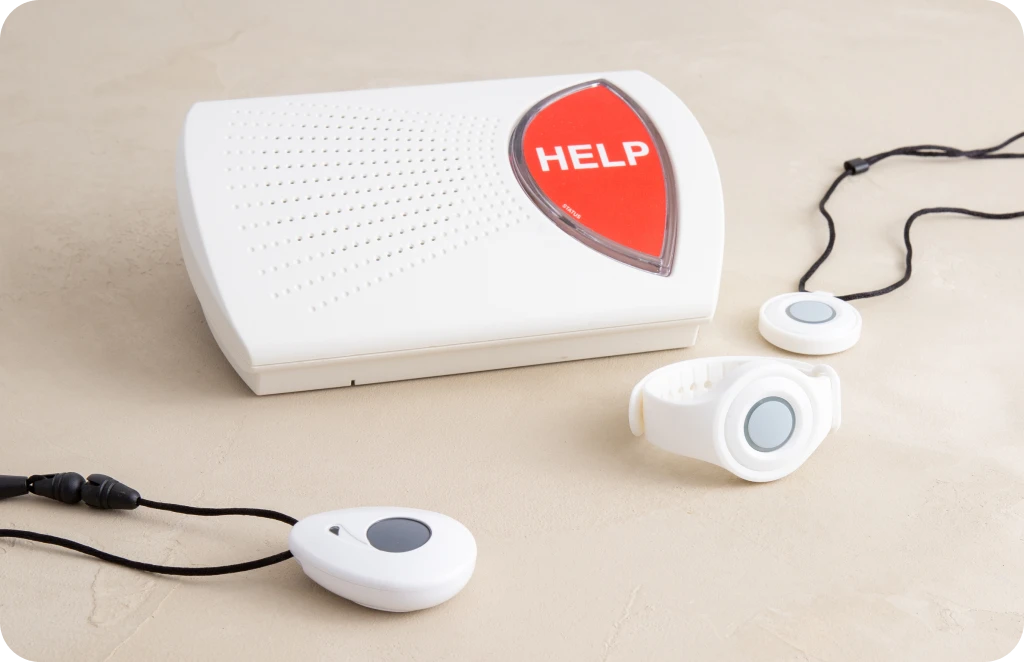
The SOS Home system serves as Bay Alarm Medical’s foundation product, ideal for seniors who spend most of their time at home. This traditional console connects to either a landline (starting at $27.95 monthly) or cellular network ($34.95 monthly). The system includes a base unit with a bright red help button and two-way speaker, plus a wearable help button that can be worn on a wristband or lanyard.
The exceptional range impressed us most during testing – the wearable help button works up to 1,000 feet from the base station (equivalent to three football fields). This coverage surpasses the 600-foot range of the All-in-One 2 system, making it perfect for larger homes or properties. The system responds quickly, with an average response time of just 31 seconds in testing.
The SOS Home includes a 32-hour backup battery for power outage protection. The base station provides clear audio confirmation of connectivity, announcing “LTE, five bars” when properly connected to the cellular network.
SOS Micro: Lightweight and Simple Design
The SOS Micro represents Bay Alarm Medical’s most compact offering. About the size of a traditional watch, this lightweight device (weighing just 0.7 oz) features a minimalist design without sacrificing essential safety features. It comes with multiple wearing options, including a lanyard, wristband, or belt clip attachment.
The device offers up to 36 hours of battery life between charges, though testing revealed actual performance closer to 48 hours. The Micro connects through either AT&T or Verizon’s 4G LTE networks (your choice based on which provider offers better coverage in your area), and includes both GPS and Wi-Fi positioning for accurate location tracking.
Testing showed the SOS Micro connected to response operators in an average of just 16 seconds. The optional fall detection feature successfully detected seven out of ten test falls, demonstrating reasonable reliability. Priced at $34.95 monthly (or $44.95 with fall detection), the Micro requires a one-time equipment fee of $149.00.
SOS Smartwatch: Discreet Wearable with GPS
The SOS Smartwatch offers a stylish alternative for those who prefer a less clinical-looking medical alert device. Unlike most smartwatches, it doesn’t require pairing with a smartphone – it functions independently via 4G LTE cellular connection.
The watch features a dedicated SOS button on the side that connects directly to Bay Alarm Medical’s monitoring center. Testing revealed it delivered the fastest response time of any Bay Alarm device, connecting within 10 seconds. The smartwatch includes practical features like a step counter, time display, and local weather information without unnecessary apps that would drain the battery.
However, the battery life ranges from only 6-18 hours depending on settings and connectivity, which is noticeably shorter than other Bay Alarm devices. Fall detection is available as an optional add-on, and it uses AI technology that learns your movement patterns over time, resulting in improved accuracy by the end of a week’s testing.
SOS All-in-One 2: Hybrid System for Home and Travel
The All-in-One 2 functions as a solution that works both at home and on-the-go. This versatile system includes:
- Built-in emergency button and two-way speaker
- 72-hour battery life
- Water-resistant design for shower use
- Dual GPS/Wi-Fi positioning for precise location tracking indoors and outdoors
- Optional automatic fall detection
- Free caregiver tracking app for iOS and Android
The system uses AT&T’s 4G LTE network for connectivity, providing faster response times and improved battery performance compared to older cellular technologies. At $34.95 monthly (or $44.95 with fall detection) plus an $89.40 equipment fee, it represents a middle-ground option in Bay Alarm’s lineup.
One potential drawback: the All-in-One 2 provides a 600-foot range between the wearable button and main console, compared to the 1,000-foot range offered by the SOS Home system.
Hidden Costs: What You Might Miss in the Fine Print
Bay Alarm Medical claims “no hidden fees” on their website, but several expenses can catch you off guard if you don’t read carefully. Understanding these additional costs helps you budget accurately, as the advertised monthly rates represent only part of your total investment.
Monthly Monitoring Fees by System
Bay Alarm Medical’s pricing varies across their product lineup. The SOS Home system starts at $27.95 monthly for landline connections and $34.95 for cellular service. The mobile SOS Micro costs $34.95 monthly, while the SOS Smartwatch requires a higher monthly fee of $39.95. The hybrid SOS All-in-One 2 system costs $34.95 per month.
Adding fall detection capability increases your monthly expense by $10 across all systems. An SOS Home with fall detection costs $44.95 monthly, representing a 29% increase over the base price. Bay Alarm’s pricing becomes more competitive when you choose quarterly or annual payment plans, which include free shipping. Annual subscribers also receive one free month of service, though this benefit isn’t immediately obvious during initial shopping.
Equipment and Activation Charges
While Bay Alarm Medical advertises “no activation fees”, several systems require upfront equipment payments. The SOS Home console stands alone with no equipment fees, as these units are leased rather than purchased. The SOS Micro and SOS Smartwatch require one-time equipment fees of $149 and $199 respectively. The SOS All-in-One 2 system requires an $89.40 equipment payment.
These equipment charges aren’t always prominently displayed in marketing materials, potentially creating surprise expenses at checkout. Bay Alarm Medical does disclose all charges during the final ordering process.
Add-On Features: Fall Detection, Lockbox, Wall Buttons
Beyond base system costs, several add-on features can increase your total investment:
- Fall detection pendant: $10 monthly plus a one-time $30 equipment fee
- Lockbox for emergency access: $30 one-time purchase
- Wall buttons for high-risk areas: $35 each or four for $130 (a $10 savings)
- Additional wearable buttons: $39-40 each
- Bella Charms (jewelry-like button covers): $25 each
- Bella Bands (colorful wristbands): $17 each
- Vial of Life kit (medical information storage): $8 each, though free with new subscriptions
- Additional charger: $49
Bay Alarm Medical allows couples to share monitoring services without additional monthly fees by simply purchasing an extra wearable button. This represents good value for households with multiple users.
Warranty and Replacement Costs
The standard warranty covers only manufacturing defects and normal wear and tear. For protection against damage, loss, or theft, you’ll need their Premier Protection Plan, priced between $2.95-$4.95 monthly depending on your system. This plan includes one free system replacement annually and a 50% discount on lost or damaged accessories.
Without this protection, you could face replacement costs up to $299 for damaged equipment. Early cancelation of quarterly or annual plans results in prorated refunds minus shipping costs and any promotional discounts received. The fine print reveals that free shipping requires at least three months of paid service, while the “free month” promotion requires eleven months of paid service.
Bay Alarm Medical offers a 15-day trial period, which is shorter than some competitors’ 30-day evaluation periods, giving you less time to test the system thoroughly.
Real Response Times: What Our Testing Revealed
Testing Bay Alarm Medical devices revealed significant variations between marketing claims and actual performance. These differences can affect emergency response effectiveness when every second matters.
Average Connection Time Across Devices
Bay Alarm Medical advertises response times “typically in less than 45 seconds”, but actual performance varies substantially across devices. Independent test results showed response times fluctuating between 10-50 seconds:
- Caring.com reports Bay Alarm Medical has “the fastest average response time of any company we reviewed, at an average of 10 seconds”
- NCOA’s testing revealed an average response time of 31 seconds
- SafeHome testing showed “the average response time was less than 30 seconds”
- Forbes Health trials measured consistent 30-31 second response times across multiple devices
The SOS Smartwatch delivered the quickest connections at approximately 10 seconds, with the SOS Micro following at around 16 seconds. The SOS Home averaged 31 seconds in multiple trials, which falls within industry standards of 15-45 seconds.
However, TechRadar’s independent testing uncovered concerning inconsistencies, including “an average of approximately 50 seconds, which exceeded the industry standard”. More troubling, they documented “two instances where calls remained unanswered after a duration of five minutes”, though Bay Alarm proactively called back on a separate line in both cases.
Fall Detection Accuracy and Delays
Automatic fall detection technology presents one of the most challenging aspects of medical alert systems. Bay Alarm Medical’s fall detection capabilities proved functional yet imperfect during testing.
The fundamental challenge involves detecting various fall types accurately. According to Bay Alarm’s documentation, “Sudden falls are generally easier to detect with accuracy than slow or gradual falls”. This limitation became evident in testing, where the SOS Home system successfully detected 3 out of 3 test falls, while the SOS Micro detected only 7 out of 10.
Forbes Health testing revealed more concerning results: “the fall detection worked when the pendant was dropped but not when a genuine fall took place”. This reflects their admission that “false alarms and missed falls remain challenges” for the technology.
Bay Alarm uses accelerometers and gyroscopes coupled with AI algorithms to identify falls. The SOS Smartwatch employs more advanced AI technology that “learns your movement patterns over time,” resulting in improved accuracy after about a week of use.
GPS Tracking and Location Precision
Location accuracy forms a critical component of any mobile medical alert system. Bay Alarm Medical employs a dual-technology approach:
- GPS technology for outdoor location tracking
- WiPS (WiFi Positioning System) for indoor precision
This combination provides “pinpoint-accurate location tracking“, allowing operators to know “exactly where the device is in an emergency rather than a general area”. This precision becomes crucial when users cannot verbally communicate their location.
According to Bay Alarm, “if you are too disoriented to speak… our operator can quickly find your location”. Testing showed the GPS tracking accurately pinpointed location within seconds of button activation.
The 4G LTE connectivity enhances this capability, providing “better coverage, faster response times, and pinpoint accurate location tracking”. Location services worked effectively across all mobile devices, with the SOS All-in-One 2 demonstrating the most consistent indoor/outdoor tracking capability.
Two concerning incidents emerged during TechRadar’s testing when “the system initiated two false alarms when no individuals were present, resulting in the dispatch of an ambulance to our testing facility on both instances”. This suggests potential oversensitivity in certain scenarios.
Ease of Use and Setup Experience
Setting up a medical alert system should never require technical expertise, which Bay Alarm Medical clearly understood when designing their products. Testing revealed their “plug-and-play” setup truly needs no special tools or technical knowledge.
Installation Process for Each System
The SOS Home system requires minimal effort to get started. For landline connections, you connect the base unit to your phone wall jack and plug it into a power outlet. The cellular version needs positioning near a window for optimal signal and access to power. Once plugged in, the unit announces “System ready” with a green status light.
The SOS All-in-One 2 requires only charging until the indicator light turns solid red. The SOS Micro fits into its charging cradle, which blinks red during charging. Clear labeling and simple instructions make the process straightforward. One tester noted, “I liked the slim size of the package and how it contained just the necessities”. Bay Alarm Medical provides short instructional videos on their website to support this simple setup process.
Mobile App Functionality and Caregiver Tools
Bay Alarm Medical offers a mobile app that enhances caregiver oversight. The caregiver tracking platform shows:
- Real-time location on Google Maps (updating every 30 seconds)
- Battery charge status and notifications
- Step counting and goal setting
- Fall detection status
The app includes a “ring device” function to help locate misplaced units. For caregivers managing multiple seniors, the platform allows adding multiple users under one account.
Accessibility for Seniors with Hearing or Dexterity Issues
Several features support accessibility during testing. The SOS Home provides verbal confirmation of connectivity, announcing “LTE, five bars” after each reset. This helps reassure users with hearing concerns that their system remains connected.
Some considerations apply. The SOS Smartwatch’s metal clasp might present challenges “for older adults with arthritis or dexterity problems”. Bay Alarm Medical offers solutions like decorative Bella Charm necklace covers or Bella Bands that convert wristbands into watch-like accessories, helping address the stigma sometimes associated with medical devices.
Customer Support and Service Quality
Customer service quality becomes crucial when you need help during an emergency or have questions about your device. Bay Alarm Medical provides support options that address different communication needs and preferences.
Live Chat, Phone, and Language Support
Bay Alarm Medical offers customer service seven days a week, with representatives available Monday through Friday from 6 a.m. to 6 p.m. PT, plus weekend hours from 8 a.m. to 4:30 p.m. PT. During testing, connection with a representative took under a minute, and they proved empathetic and helpful when explaining device options rather than pushy about sales.
Language support stands out as a key feature, with service available in over 170 languages, including Greek, Spanish, Chinese, Farsi, Vietnamese and Russian. This addresses an important need, as approximately one in five Americans speaks a second language at home.
Return Policy and Risk-Free Trial
Bay Alarm Medical provides a 15-day trial period, not the 30 days some sources incorrectly claim. This timeline begins when you receive your equipment. If you’re not satisfied within this window, you receive a full refund minus shipping costs. For cancellations after this period, Bay Alarm Medical provides prorated refunds for unused months. The company operates without long-term contracts or cancellation fees.
User Feedback from Bay Alarm Medical Reviews
Customer satisfaction ratings reach 93% for “very positive and helpful” interactions with service representatives, exceeding the industry average by 12%. One customer shared: “When daddy passed away, return of the system was easy, and their customer service was both compassionate and efficient. There were no hidden fees, no surprises whatsoever”.
The standard warranty covers manufacturing defects and normal wear. The optional Premier Protection Plan ($2.95-$4.95 monthly) provides one free system replacement annually plus 50% discounts on accessories.
Bottom Line
Bay Alarm Medical delivers reliable emergency response with a 31-second average connection time and 93% customer satisfaction rating. The straightforward setup process makes these systems accessible for seniors who want emergency protection without technical complications.
Each system addresses different needs. The SOS Home offers excellent 1,000-foot range for larger properties, while the Smartwatch provides discreet protection despite shorter battery life. The All-in-One 2 balances home and mobile coverage effectively for active seniors.
You should expect to pay more than the advertised monthly rates. Equipment fees of $89.40 to $199, plus optional add-ons like fall detection ($10 monthly), increase your total investment. The Premier Protection Plan offers valuable coverage against damage or loss for those concerned about replacement costs.
Fall detection accuracy varies significantly across devices-from 3 out of 3 successful detections on one system to only 7 out of 10 on another. The AI-enhanced smartwatch shows improvement potential with its learning capabilities.
Customer service stands out with support in over 170 languages and consistently helpful representatives. However, the 15-day trial period gives you less time to test the system compared to some competitors.
Bay Alarm Medical offers solid emergency protection, particularly if fast response times and excellent customer service matter most to you. Consider your specific needs-home versus mobile coverage, budget for additional costs, and importance of fall detection accuracy-when choosing between their systems.
Key Takeaways
Bay Alarm Medical delivers impressive emergency response performance, but understanding the complete cost structure is essential before committing to their service.
• Bay Alarm Medical achieves a 31-second average response time with 93% customer satisfaction, outperforming industry standards by 12%
• Hidden costs include equipment fees ($89-$199), fall detection add-ons ($10/month), and protection plans ($2.95-$4.95/month) beyond advertised rates
• Fall detection accuracy varies significantly across devices, detecting only 7 out of 10 test falls on some systems despite AI technology
• The SOS Home offers superior 1,000-foot range for large properties, while the Smartwatch provides discreet protection with shorter battery life
• Support for 170+ languages and no long-term contracts make Bay Alarm Medical accessible, though the 15-day trial period is shorter than competitors
Bay Alarm Medical represents a solid choice for medical alert systems, particularly for users prioritizing fast response times and excellent customer service, but careful evaluation of total costs and specific device limitations is crucial for making an informed decision.
FAQs
Q1. What is the average response time for Bay Alarm Medical? Bay Alarm Medical has an impressive average response time of 31 seconds, which is faster than many competitors in the industry. This quick response ensures that help is available promptly when needed.
Q2. Are there any hidden costs associated with Bay Alarm Medical systems? While Bay Alarm Medical advertises no hidden fees, there are additional costs to consider. These include equipment fees ranging from $89 to $199 depending on the system, optional fall detection for $10 per month, and a Premier Protection Plan for $2.95-$4.95 monthly.
Q3. How accurate is the fall detection feature in Bay Alarm Medical devices? The accuracy of fall detection varies across Bay Alarm Medical devices. Some systems detected all test falls, while others only detected 7 out of 10. The SOS Smartwatch uses AI technology that improves accuracy over time by learning the user’s movement patterns.
Q4. What languages does Bay Alarm Medical support? Bay Alarm Medical offers exceptional language support, with services available in over 170 languages. This includes common languages like Spanish, Chinese, and Russian, as well as less common ones, ensuring accessibility for a diverse range of users.
Q5. Is there a trial period for Bay Alarm Medical systems? Yes, Bay Alarm Medical offers a 15-day risk-free trial period. This begins from the day you receive the equipment. If you’re not satisfied within this timeframe, you can return the system for a full refund, minus shipping costs.